
How Do You Specify the Right Load Cell for Onshore Oil and Gas Applications? 📰
30th Jun 2026When Onshore Can Be As Challenging As Offshore
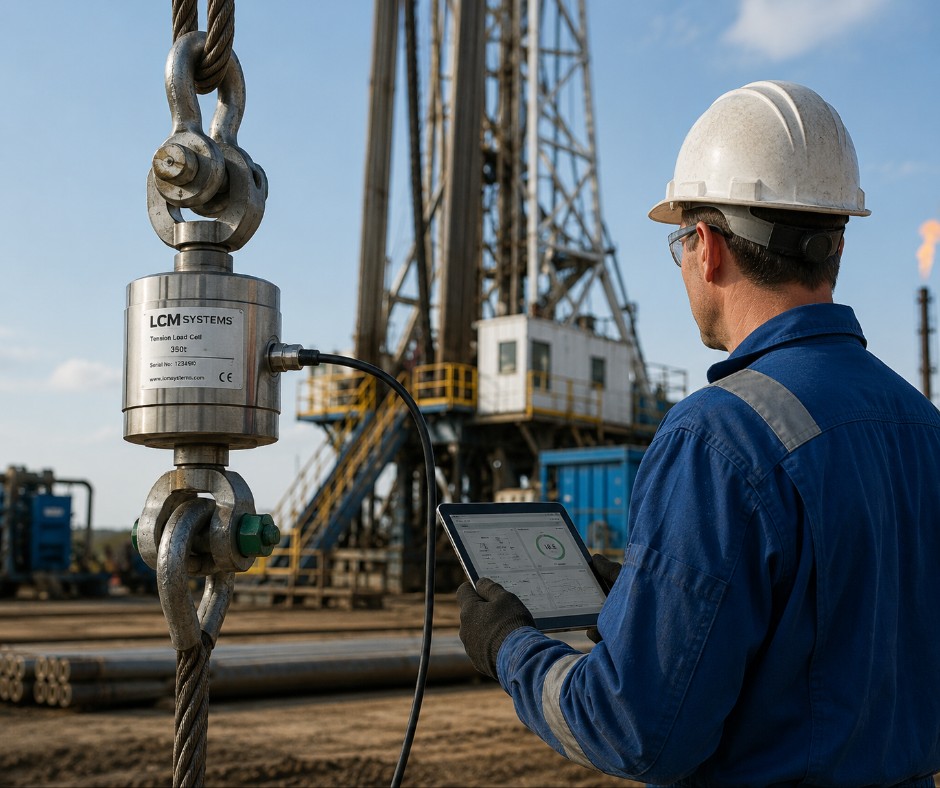
Onshore does not mean benign. A refinery lifting operation, land rig hook load system or HDD pipeline pull can impose forces, risks and certification requirements every bit as serious as an offshore topside application.
Onshore oil and gas load cells are used across land drilling rigs, workover equipment, pipeline construction, refineries, petrochemical plants, tank farms and LNG terminals. These environments differ from offshore locations because they are not usually exposed to continuous seawater immersion or severe marine loading. However, they can still be extremely demanding. Typical onshore conditions include shock loading, vibration, mud, dust, washdown, chemical exposure, temperature variation, explosive atmospheres and high cyclic loading.
Specifying load cells for onshore oil and gas operations is not simply a matter of selecting a capacity and output signal. The sensor must be matched to the mechanical load path, duty cycle, hazardous-area classification, environmental exposure, accuracy requirement and installation geometry. A poorly specified load cell may still produce a signal – but not necessarily a measurement that is reliable, repeatable or safe enough.
Start With The Load Path
Good load cell specification starts with understanding how the force is transferred through the structure. The load cell must be placed where it measures the force of interest, not just a convenient nearby reaction.
For drilling rigs, this may involve hook load measurement, deadline anchor load measurement, travelling block loads or sheave pin loads. For pipeline pulling and HDD, the force may be measured directly using a tension load cell or load shackle in line with the pulling arrangement. For process weighing, compression load cells are normally installed under vessels, tanks or support structures.
The load path should be as direct as possible. Bending moments, side loads, eccentric loading and torsional effects can introduce significant measurement errors. In many cases, these mechanical errors can be more important than the nominal accuracy of the sensor itself. A 0.1% load cell installed badly can perform worse than a lower-specification load cell installed correctly.
Compression Load Cells
Compression load cells are typically used for tank weighing, vessel weighing, structural load monitoring, test rigs and process weighing. In onshore oil and gas, they are often found beneath storage tanks, silos, pressure vessels, process skids and structural supports.
Key specification factors include rated capacity, combined error, creep, repeatability, temperature compensation, baseplate stiffness and load introduction method. The load should be applied axially through the designed loading point. Any misalignment, poor foundation stiffness or uneven support settlement can create parasitic loads that affect accuracy and long-term stability.
For multi-support vessel weighing, engineers must consider load distribution. A vessel supported on four or more load cells will rarely distribute load perfectly evenly. Pipework, thermal expansion, wind loading, agitators and structural deflection can all create uneven reactions. The load cell system must therefore be specified with enough capacity margin to accommodate the most heavily loaded support – not simply the total vessel mass divided by the number of supports.
Tension Load Cells
Typical onshore oil and gas applications for tension load cells include winch monitoring, pipeline pulling, coiled tubing tension, wireline tension, test rigs and suspended load measurement.
The most important consideration is axial alignment. Tension load cells are designed to measure force along their primary axis. Clevises, rod ends, shackles and link plates should be selected to minimise bending. If the assembly allows side loading, the measurement will become less reliable and the load cell may experience stresses it was not designed to withstand.
Dynamic effects are especially important in drilling and pipelines. A pipeline pull may have a steady average tension but there may also be short-duration spikes caused by friction changes, ground conditions or winch behaviour. A coiled tubing unit may experience rapid load changes as downhole conditions alter. The load cell capacity must therefore account for peak load, overload protection and fatigue duty – not just normal operating load.
Load Pins
Load pins are often the most elegant option where force measurement must be integrated into existing mechanical equipment. They replace a conventional load-bearing pin in a sheave, clevis, pivot, shackle, winch, drilling system or pipe handling mechanism.
The advantage is mechanical integration. The disadvantage is that the measurement depends heavily on the surrounding structure. A load pin measures strain in the pin body caused by the applied load. If the mating brackets, bearing surfaces or clearances are poorly controlled, the calibration condition may not match the installed condition.
Engineers should specify the pin diameter, bearing length, load direction, end constraints, lubrication conditions and consider expected side loads. Anti-rotation features are often required so the load pin remains correctly orientated relative to the load direction. For critical operations, dual strain gauge bridges may be specified to provide redundancy or independent monitoring channels.
Load pins are particularly useful on land rigs, pipe handling equipment, sheaves, crown blocks, deadline anchors, mast raising equipment and OEM machinery where a conventional load cell would be difficult to install.
Load Shackles
Load shackles are widely used for lifting, rigging, winching, test loading and pipeline installation. They are practical because they fit naturally into existing lifting arrangements and can often be used without major engineering changes.
For onshore oil and gas work, load shackles are commonly specified for crane lifts, skid handling, pipeline pulling, temporary load monitoring and maintenance operations in refineries and petrochemical plants.
The main specification points are working load limit, proof load, ultimate load, accuracy, shackle geometry, pin orientation, environmental sealing and whether a cabled or wireless system is required. Wireless load shackles can be useful for temporary monitoring, heavy lifting and rigging operations where cables would be vulnerable or impractical.
However, engineers should remember that a load shackle is still part of a lifting system. It must be specified not only as an instrument but also as a load-bearing component. The mechanical rating, traceability, calibration, proof testing and safety factor are therefore as important as the measurement output.
Selecting the Correct Capacity
Capacity selection is one of the most important parts of load cell specification. The rated capacity must be high enough to survive the real operating conditions but not so high that useful resolution is lost.
Engineers should consider the maximum working load, dynamic amplification, shock loads, overload capacity, fatigue life, proof load, ultimate load and any foreseeable abnormal conditions. Often in onshore oil and gas, the most severe load is not the normal operating load but a transient event.
For example, hook load monitoring may see sudden changes due to stuck pipe or downhole restriction. Pipeline pulling can generate load spikes due to friction changes or pipe movement. Lifting operations may involve dynamic factors caused by crane movement, wind, snagging or uneven load transfer.
A useful specification approach is to define the normal operating range, maximum expected operating load, maximum credible overload and required safety factor. The load cell can then be selected so that the normal operating range falls within a useful portion of the sensor output whilst maintaining sufficient mechanical protection.
Accuracy, Resolution and Repeatability
Accuracy should be specified in relation to the actual engineering requirement. Not everything in onshore oil and gas needs laboratory-level accuracy. However, there must be dependable and repeatable measurement under real site conditions.
Important performance terms include non-linearity, hysteresis, repeatability, creep, zero balance, temperature effect on zero, output and long-term stability. Repeatability and environmental stability can be as essential as headline accuracy.
Resolution is also important, particularly when the measured load is a small proportion of the rated capacity. Oversizing a load cell may improve mechanical robustness but it can reduce useful signal resolution. This is one reason why simply choosing the largest possible load cell is not always good engineering practice.
Environmental Protection
Onshore oil and gas equipment may require strong environmental protection – even when it is far from the coast. Outdoor land rigs and pipeline projects are likely to face rain, mud, dust, impact and temperature cycling. Refineries and petrochemical plants may expose equipment to chemicals, vapours and washdown procedures.
Ingress protection should be selected based on the actual exposure. IP 67 may be suitable for temporary immersion or heavy outdoor use. IP 68 may be required where prolonged immersion, flooding or aggressive washdown is possible. For coastal LNG terminals and marine loading facilities, offshore-style sealing and corrosion protection may be appropriate, even though the installation is technically onshore.
Material selection is equally important. Stainless steel is often preferred for oil and gas load cells because it provides good corrosion resistance and long-term durability. In more aggressive environments, higher-grade stainless steels or specialist materials may be required.
Cable entries and connectors are common failure points. A tough sensor body is of little value if moisture enters through the cable gland or connector. For outdoor and hazardous-area installations, connector specification, cable protection, strain relief and sealing detail should be considered carefully.
Hazardous-Area Certification
Hazardous-area certification is required when the load cell or instrumentation is installed in a classified area where explosive gas, vapour or dust may be present. This is common in refineries, petrochemical plants, LNG facilities, tank farms, drilling sites and some pipeline installations.
ATEX certification is commonly required in Europe and the UK, while IECEx is widely used for international projects. The required certification depends on the zone classification, gas group, temperature class, equipment protection level and protection concept.
Intrinsically Safe systems limit electrical energy so that ignition cannot occur under defined fault conditions. Flameproof systems are designed to contain an internal explosion and prevent flame propagation to the surrounding atmosphere. The correct choice depends on the intended role, installation method, wiring arrangement and site safety protocols.
Hazardous-area requirements should be established at the start of the project. They affect not only the load cell but also amplifiers, displays/instrumentation, junction boxes, barriers and cabling.
Output and Instrumentation
The load cell output must suit the control or monitoring system. Traditional strain gauge load cells commonly provide an mV/V output, requiring a suitable amplifier or indicator. Other systems may require 4-20 mA, 0-10 V, CAN, RS485, digital telemetry or wireless output.
For process plants and refineries, integration with PLC or SCADA systems may be required. For temporary lifting or pipeline work, portable displays, handheld indicators or wireless telemetry may be more practical. For testing, commissioning and monitoring, data logging is likely to be important.
The instrumentation should be specified as part of the system – not as an afterthought. Poor signal conditioning, unsuitable cabling or incorrect earthing can compromise an otherwise well-designed load cell installation.
Calibration and Traceability
Calibration should reflect how the load cell will be used. A load pin calibrated in a laboratory fixture may behave differently when installed in a specific mechanical assembly. A multi-load-cell vessel weighing system may require corner adjustment, system calibration or site verification after installation.
For critical oil and gas applications, engineers should specify calibration certificates, material traceability, proof testing and any required witness testing. Documentation may include certificates for calibration, conformity, material and hazardous areas, along with test records.
Traceability is particularly important where the load cell is part of a safety-critical lifting, monitoring or control system.
Selecting the Right Partner
Specifying load cells for oil and gas is a multidisciplinary task. It involves mechanical design, instrumentation, hazardous-area compliance, environmental engineering and calibration practice.
LCM Systems designs and manufactures load cells, load pins and load shackles for demanding onshore oil and gas operations. Our products are used in drilling, pipeline construction, refineries, petrochemical plants, LNG terminals and heavy lifting operations where safety, accuracy and reliability are critical.
Get Expert Technical Advice
Selecting the right force measurement solution involves much more than specifying a capacity. Factors such as load path, dynamic loading, fatigue life, environmental conditions, hazardous-area certification and mechanical integration can all have a significant impact on performance and reliability.
Our engineering team has extensive experience supporting projects across drilling operations, pipeline construction, refineries, petrochemical plants, LNG terminals and hazardous-area environments worldwide.
Contact LCM Systems today to discuss your requirements and discover how our load cells, load pins and load shackles can deliver accurate, reliable force measurement in onshore oil and gas.
Contact our specialist team for expert technical advice.