
How Is Hook Load Best Measured on Onshore Drilling Rigs? 📰
18th Jun 2026Hook load is one of the most important operating parameters on any drilling rig. It represents the total vertical load suspended beneath the travelling block and hook assembly, including the drill string, bottom hole assembly, casing, tubing or any other equipment being handled by the hoisting system.
Accurate hook load measurement is fundamental to drilling efficiency, equipment protection and operational safety. Drillers rely on hook load data to monitor drilling conditions, detect abnormal downhole events, optimise weight-on-bit calculations and ensure that lifting equipment remains within its rated capacity. In modern drilling, hook load measurement also forms a critical input into rig control systems, data acquisition platforms and digital drilling analytics.
The Physics Behind Hook Load Measurement
Hook load is ultimately a force generated by gravity acting on the suspended mass beneath the hook. However, the actual force experienced by the rig’s hoisting system is influenced by a range of dynamic factors.
As drill pipe is lowered or raised, acceleration and deceleration introduce transient loads that can exceed static weight calculations. Friction within the travelling block, crown block and drilling line can affect load distribution. Shock loading may occur during pipe handling operations, while vibration generated by drilling activities can introduce significant measurement noise.
The force being measured may range from a few tonnes during routine pipe handling to several hundred tonnes during deep drilling or casing. The measurement system must therefore maintain high accuracy across a wide operating range while remaining stable under dynamic loading conditions.
For this reason, hook load is typically measured directly within the load path using specialised force transducers, rather than relying solely on indirect calculations.
Accurate Hook Load Measurement Matters
The primary purpose of hook load measurement is operational control. Drillers continuously compare measured hook load against expected values to assess drilling performance and identify anomalies.
Changes in hook load can indicate stuck pipe conditions, differential sticking, excessive drag, hole instability or downhole obstruction. During tripping, hook load trends provide valuable information about wellbore conditions and equipment behaviour – enabling the detection of downhole problems before they escalate into high-cost incidents.
From a structural perspective, accurate load measurement protects critical rig components including the mast, crown block, travelling block, drawworks and drilling line. Exceeding design loads can lead to accelerated wear, costly downtime or catastrophic equipment failure.
Regulatory compliance and safety management systems also increasingly require reliable load monitoring and traceable calibration records – particularly on high-value drilling projects.
Where Is Hook Load Typically Measured?
Several locations within the hoisting system may be used to measure hook load, depending on rig design and operational requirements.
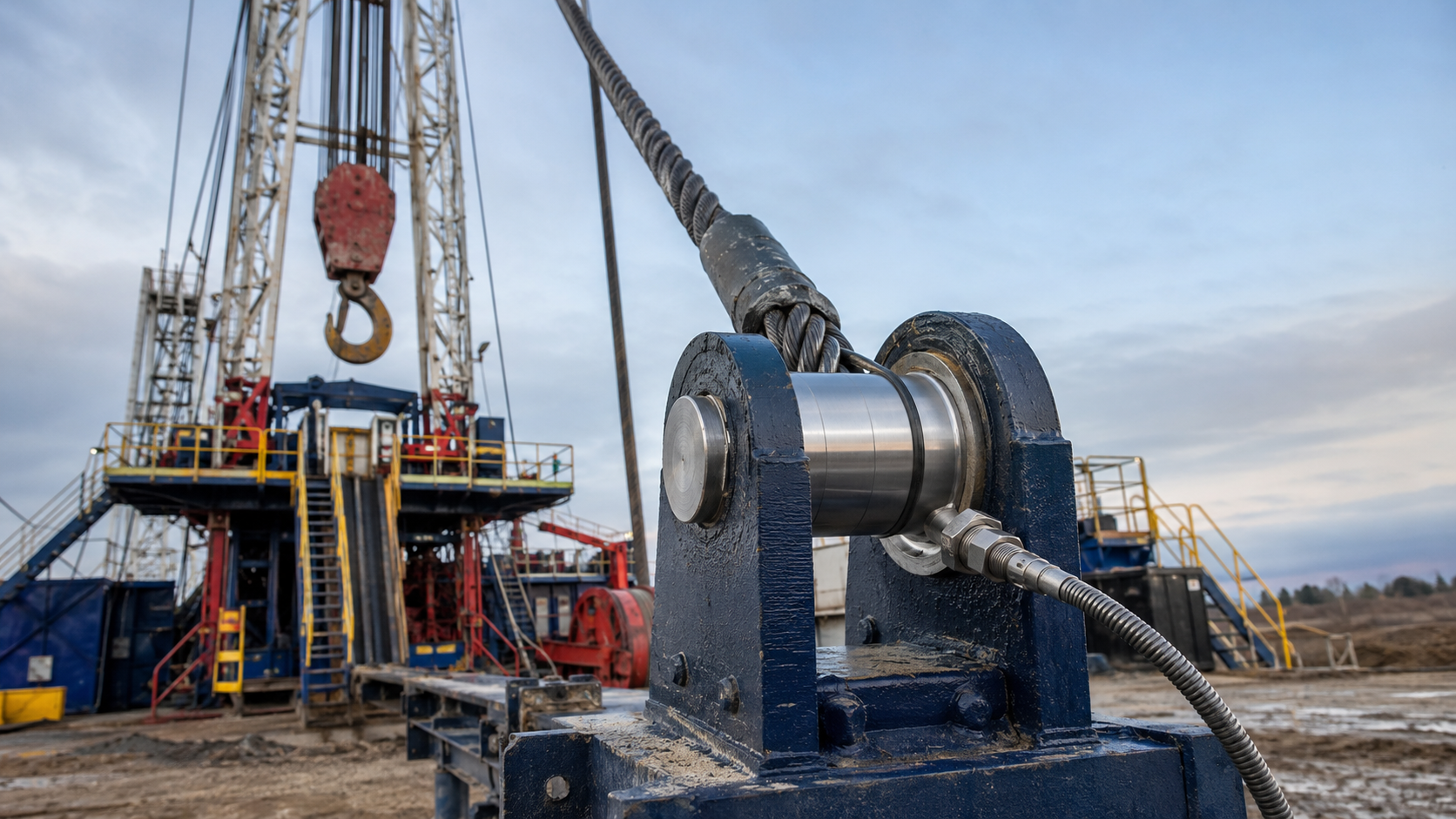
The deadline anchor is a common measurement point. By measuring the tension in the deadline and applying the appropriate block-and-tackle calculations, the total hook load can be determined. This approach is widely used because it allows force measurement equipment to be installed away from the travelling equipment.
Direct measurement methods are becoming increasingly popular where higher accuracy is required. These typically involve instrumented load pins installed within sheave assemblies, equaliser systems or structural pivots carrying the load path. Load shackles may also be incorporated into temporary lifting arrangements associated with rig-up, maintenance or specialist handling operations.
The choice of measurement location has a significant impact on achievable accuracy, installation complexity and long-term reliability.
Special Considerations for Onshore Oil and Gas
Unlike fixed manufacturing installations, drilling rigs are routinely transported between sites, erected, dismantled and reconfigured. Force measurement equipment must therefore withstand repeated handling, transportation shock and changing installation conditions.
Equipment may be exposed to desert heat, Arctic temperatures, abrasive dust, mud contamination, vibration, hydraulic fluids and continuous mechanical shock. Temperature variation alone can create substantial measurement drift if the sensing system is not properly compensated.
Power quality and communications infrastructure may also vary considerably between drilling locations. Instrumentation must therefore maintain performance despite electrical noise, generator fluctuations and long cable runs.
In addition, drilling frequently involves cyclic loading over extended periods. Fatigue performance becomes a vital design consideration, particularly for load pins operating within continuously moving assemblies.
How Onshore Requirements Differ from Offshore Applications
Although both sectors require highly reliable force measurement, offshore and onshore drilling environments create different engineering priorities.
Offshore installations place greater emphasis on corrosion resistance due to continuous exposure to saltwater and marine atmospheres. Enhanced environmental sealing and materials such as duplex stainless steel are often specified as standard.
Onshore drilling environments generally present less severe corrosion risks but place greater demands on mobility, ruggedness, resistance to dust, impact damage and transportation-related stresses. Equipment may experience repeated installation cycles throughout its service life, creating additional requirements for mechanical robustness and ease of maintenance.
Hazardous area considerations can also differ. While both sectors frequently call for ATEX or IECEx certification, the specific gas groups, temperature and area classifications may vary according to field conditions.
From a commercial perspective, onshore projects often demand solutions that combine high performance with rapid deployment and minimal rig modification.
Specifying Load Cells, Pins and Shackles for Hook Load Measurement
Capacity selection is critical in successful hook load measurement. Engineers must consider not only maximum static hook load but also dynamic loading, shock factors and future operational requirements.
Under-specifying risks overload damage, while excessive oversizing can reduce accuracy and measurement resolution.
Accuracy requirements should be defined clearly. Factors such as installation geometry, signal conditioning, calibration procedures and structural interactions must all be considered.
Fatigue resistance is particularly important for load pins installed within moving sheaves and rotating equipment. Designs should be assessed for long-term cyclic loading performance rather than static strength alone.
Environmental sealing should be suitable for continuous exposure to water, drilling fluids, dust and pressure washing. High ingress protection ratings and robust connector systems are typically required.
Where rigs operate in hazardous areas, appropriate ATEX, IECEx or equivalent certification may be mandatory. Certification requirements should be defined early in the specification process to avoid costly redesigns later.
Signal output must also be considered. Modern drilling systems commonly require integration with PLCs, SCADA platforms, rig instrumentation systems or wireless monitoring networks. Output formats may include mV/V, 4–20 mA, CAN bus, Modbus or digital telemetry solutions.
Common Specification Mistakes
Many hook load measurement problems originate during the specification stage, rather than during operation.
One common error is specifying capacity based solely on expected working load without accounting for dynamic effects. Drilling frequently generates peak loads substantially higher than nominal values.
Another mistake is focusing exclusively on sensor accuracy while overlooking installation effects. Even a highly accurate transducer can produce poor results if structural load distribution has not been properly analysed.
Engineers also sometimes underestimate environmental influences. Temperature extremes, vibration and electrical noise can all degrade performance if not addressed through proper design and signal conditioning.
A further issue is selecting standard industrial load cells for work that requires purpose-designed load pins or load shackles. Conventional load cells often struggle to withstand the mechanical and environmental demands encountered on drilling rigs.
Force Measurement Technologies Used for Hook Load Monitoring
Several force measurement technologies are employed across the drilling industry.
Conventional compression and tension load cells are commonly used in static lifting but are often difficult to integrate directly into drilling rig structures.
Instrumented load pins are frequently the preferred solution for permanent hook load measurement. By replacing existing structural pins, they provide direct force measurement without significantly altering the original mechanical design. Properly engineered load pins offer excellent accuracy, high fatigue life and long-term reliability in demanding drilling environments.
Load shackles provide a versatile alternative where a removable force measurement solution is required. They are particularly useful during temporary lifting, equipment testing and specialist rig handling tasks.
Systems based on strain gauges remain the dominant technology due to their proven performance, stability and compatibility with drilling instrumentation systems. When combined with advanced electronics and digital signal processing, they provide highly reliable real-time hook load data.
Selecting the Right Hook Load Measurement Solution
Hook load measurement is far more than a simple weighing exercise. Accurate data depends on understanding the complete load path, the dynamic behaviour of the drilling system and the environmental conditions in which the equipment must operate.
For land-based drilling rigs, purpose-engineered load pins and load shackles often provide the most robust and reliable solution – particularly where high loads, harsh environments and long-term reliability are essential requirements.
When specifying a hook load measurement system, engineers should evaluate capacity, fatigue performance, environmental protection, hazardous area compliance, integration requirements and calibration strategy as part of a complete system design, rather than focusing solely on sensor selection.
Get Expert Technical Advice
As an experienced force measurement solutions manufacturer, LCM Systems understands precision strain gauge technology and the realities of onshore drilling. Our solutions – based on 40+ years of experience – can significantly reduce project risk, improve measurement accuracy and deliver reliable hook load data throughout the life of the rig.
Consult with our engineering team to discuss the best solution for your load path, environmental, certification and integration requirements.