
How Pipeline Pulling/HDD Load Cells Improve Safety and Efficiency in Onshore Operations 📰
17th Jun 2026Improving Safety and Efficiency In HDD and Pipeline Pulling
As Horizontal Directional Drilling projects continue to increase in length, diameter and complexity, precise load monitoring has become ever more essential in modern pipeline installation.
HDD and pipeline pulling place some of the highest force-monitoring demands found within the onshore oil and gas sector. Whether installing gathering lines, transmission pipelines, flowlines or utility crossings, engineers must accurately monitor pulling loads throughout drilling, reaming and pipe installation to prevent costly failures and ensure safe, efficient operations.
Load cells, load pins and load shackles provide the real-time force measurement needed to control these operations. They enable engineers to monitor pullback loads, verify equipment performance, protect drilling assets and maintain safe working limits.
Cutting The Cost of Horizontal Directional Drilling
Horizontal Directional Drilling is widely used to install pipelines beneath rivers, roads, railways, environmentally sensitive areas and existing infrastructure where conventional open-cut trenching is impractical.
HDD typically comprises three stages: pilot hole drilling, hole enlargement through one or more reaming passes and final product pipe pullback. Throughout each phase, significant tensile and compressive forces are generated within the drill string and pulling assembly. Excessive loading can lead to drill rod failure, damage to reamers, overstressing of swivels, deformation of the product pipe or the complete loss of the bore.
Accurate force measurement allows the continuous monitoring of loads, enabling you to react before equipment reaches critical stress levels. This reduces the likelihood of costly downtime, abandoned bores and damaged assets.
Load Cells for Pipeline Pullback Monitoring
One of the most common applications for load cells in HDD is monitoring pullback force during product pipe installation.
As the pipeline is pulled through the completed bore, friction between the pipe and surrounding ground generates significant tensile loads. These forces are influenced by numerous variables including bore length, pipe diameter, soil conditions, drilling fluid performance, bend radius and installation speed.
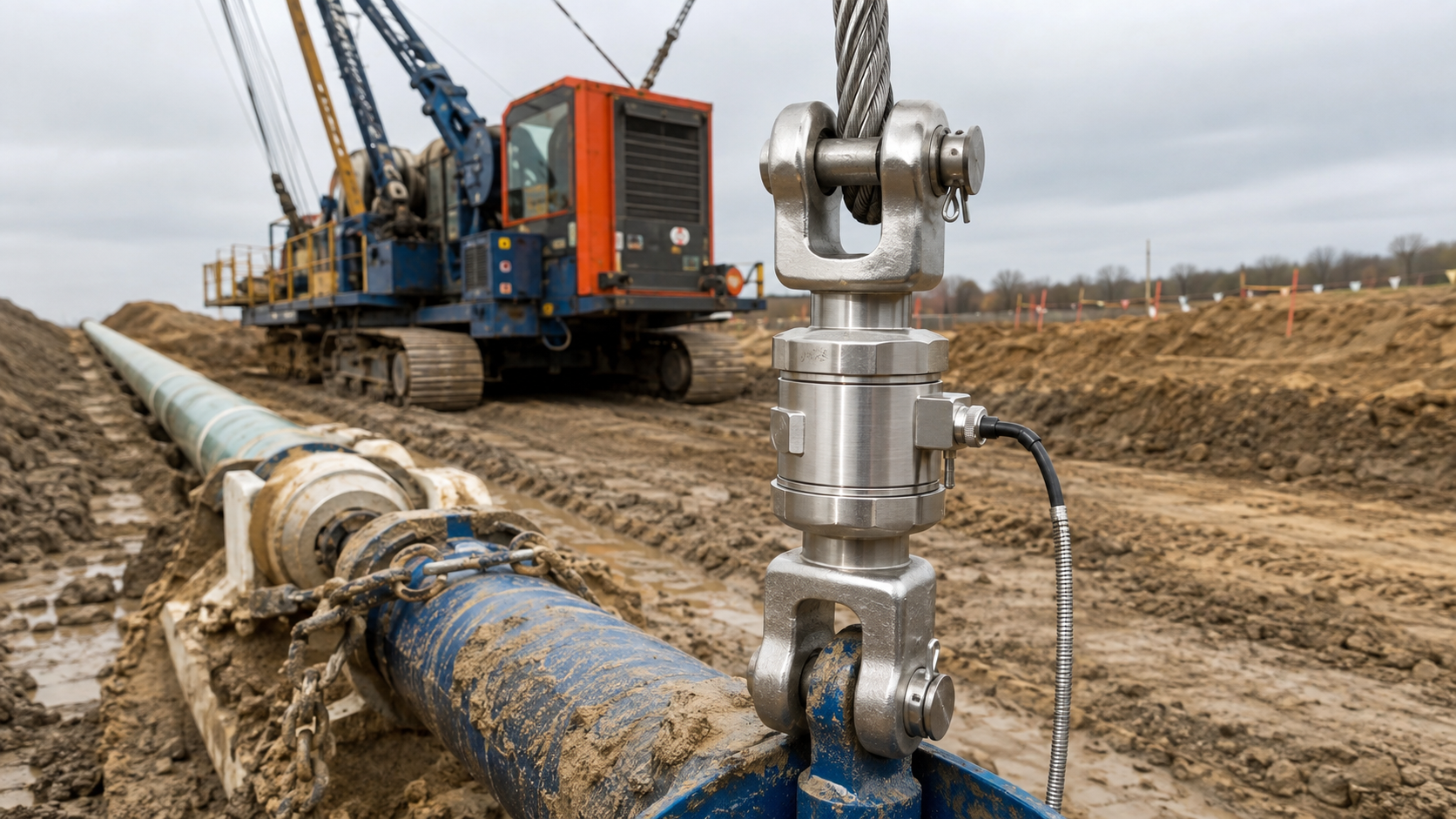
A tension load cell installed between the pull head and drilling rig provides continuous measurement of actual pullback force. Engineers can compare measured loads against calculated design limits to ensure the pipeline remains within allowable stress levels.
Real-time load monitoring is particularly important when installing high-value steel pipelines where excessive tensile loading may result in permanent deformation, coating damage or reduced service life.
For larger installations, recorded load data also provides valuable project documentation and verification that installation loads remained within specification.
Load Pins and Load Shackles in HDD Pulling Assemblies
While conventional tension load cells are frequently used during pullback, load pins and load shackles often provide more practical solutions where space constraints or rigging arrangements make traditional solutions harder to install.
Load pin technology enables force measurement to be integrated directly into existing mechanical connections. A standard pin within a pull head, sheave assembly or rigging arrangement can be replaced with a strain-gauged load pin – without altering the overall geometry of the system.
Similarly, load shackles allow engineers to combine a certified lifting or pulling connection with integrated force measurement. This approach reduces installation complexity while providing accurate load monitoring at key connection points.
Load pins and load shackles are particularly well suited to field environments where HDD equipment is often subjected to shock loading, vibration and changing load directions.
Monitoring Drill String Loads
Load monitoring is not limited to the final pullback stage.
During pilot drilling and reaming, excessive loads can develop within the drill string due to changing ground conditions, obstruction encounters or inadequate drilling fluid performance.
Monitoring axial loads helps operators to identify developing problems before they escalate into stuck pipe incidents or equipment failures.
In tricky ground formations such as dense clay, cobbles or fractured rock, force measurements can provide an early indication that drilling conditions differ from those anticipated during geotechnical investigation.
Many HDD contractors use load monitoring data alongside drilling fluid pressure, rotational torque and penetration rate measurements to build a more complete understanding of bore conditions.
Protecting Equipment and Preventing Failures
Modern HDD rigs are capable of generating several hundred tonnes of pullback force. While this capability enables increasingly ambitious installations, it can also exacerbate the consequences of overload events.
Load cells act as a critical safeguard against excessive loading of drilling equipment, reamers, swivels, pull heads and product pipe.
By continuously monitoring actual loads, you can identify increasing friction, bore collapse, binding, or fluid loss before the equipment reaches design limits.
In many systems, programmable alarms can be configured to alert you when predefined load thresholds are approached. This allows corrective action to be taken before significant damage occurs.
The cost of implementing load monitoring is typically negligible compared with the financial consequences of drill string failure, pipe damage or project delays.
Specifying Load Cells for Horizontal Directional Drilling
Specifying the correct force measurement solution requires careful consideration of the operational environment and expected loading conditions.
Capacity selection is particularly important. Engineers must consider not only predicted loads but also dynamic effects arising from rig movement, sudden releases of stored energy, stick-slip behaviour and shock loading. A load cell with insufficient overload capability may suffer damage despite operating below its nominal capacity for most of the project.
Accuracy requirements are typically less demanding than laboratory or process-control applications but reliable measurement remains essential. Most HDD requires robust load cells capable of maintaining stable performance despite vibration, temperature variation and difficult site conditions.
Ingress protection is another key consideration. HDD routinely exposes instrumentation to water, drilling fluids, mud, dust and abrasive contaminants. Stainless steel construction and environmental sealing are often preferred to ensure long-term reliability.
Signal transmission should also be evaluated. Depending on site conditions, engineers may choose wired systems, wireless telemetry or integration into central data acquisition systems for continuous monitoring and data logging.
Hazardous-Area Considerations
Many onshore oil and gas projects involve hazardous locations where explosive gas atmospheres may be present.
Where force measurement equipment is installed within classified areas, ATEX or IECEx certified load cells and instrumentation may be required. This is particularly relevant for pipeline construction activities associated with live facilities, compressor stations, gas processing plants, storage terminals and production sites.
Engineers must ensure that not only the load cell itself but also associated instrumentation, displays, wireless transmitters and power supplies are suitable for the hazardous-area classification.
The required certification will depend on the zone classification and gas group associated with the installation.
Selecting the Right Force Measurement Partner
LCM Systems designs and manufactures precision load cells, load pins and load shackles specifically for challenging industrial applications, including onshore oil and gas, pipeline construction and HDD operations. With extensive experience in custom-engineered force measurement solutions, LCM can provide equipment tailored to specific pulling capacities, rigging arrangements, environmental conditions and hazardous-area requirements.
Whether monitoring pullback forces during HDD installations, measuring drill string loads or protecting vital pipeline assets from overload, LCM Systems delivers robust and dependable force measurement solutions that are trusted across the energy sector.
Contact Our Expert Team
If you are planning HDD crossings, pipeline installation or specialist pulling, LCM Systems can help you to specify the most suitable load cells, load pins and load shackles. With 40+ years of experience, we can provide standard or custom force measurement solutions to suit your exact specifications.
Contact our engineering team today to discuss your project and discover how accurate force monitoring can improve safety, protect valuable assets and increase operational confidence.