
How Do You Specify the Right Load Cell for Offshore Lifting Applications? 📰
26th May 2026Application
A load cell solution that performs perfectly on an offshore crane may be unsuitable for a subsea lifting frame or a mooring tensioning system.
An offshore crane typically encounters intermittent dynamic loading during lifting operations. Loads are applied for relatively short periods and can fluctuate rapidly because of vessel movement, wave action, hoisting acceleration and sudden load transfer.
But mooring tensioning systems experience a very different loading profile. Instead of intermittent lifts, the system is subjected to continuous cyclic loading caused by waves, tidal movement, vessel drift, current loading and changing weather conditions – the system may experience millions of stress cycles throughout its operational life.
Robustness and Resilience
Selecting the best load cell, pin or shackle involves far more than specifying the correct load capacity. Environmental exposure, fatigue loading, hazardous area requirements, installation constraints and operational safety must all be considered.
Reliability
The safety-critical nature of offshore lifting operations makes a load cell’s reliability as important as its accuracy. Marine environments are inherently dangerous: making the right choice improves safety and reduces downtime. Anything less is not an option.
Why Offshore Lifting Presents Unique Challenges
Offshore lifting systems operate in conditions that are significantly more demanding than those encountered in most industrial environments. Vessel movement, wave motion and wind loading can introduce highly dynamic forces into offshore lifting systems – creating continual stress fluctuations and shock loading.
At the same time, offshore load monitoring equipment must withstand saltwater exposure, humidity, vibration and extreme weather conditions over extended periods – with minimal maintenance access.
In hazardous offshore areas, equipment may also require ATEX or IECEx certification to ensure safe operation in potentially explosive atmospheres.
These factors mean that offshore load monitoring equipment must be engineered specifically for marine applications – rather than adapted from standard industrial weighing systems.
Understanding the Differences Between Load Cells, Load Pins and Load Shackles
One of the first considerations when selecting offshore load monitoring equipment is deciding which type of sensing arrangement best suits the application.
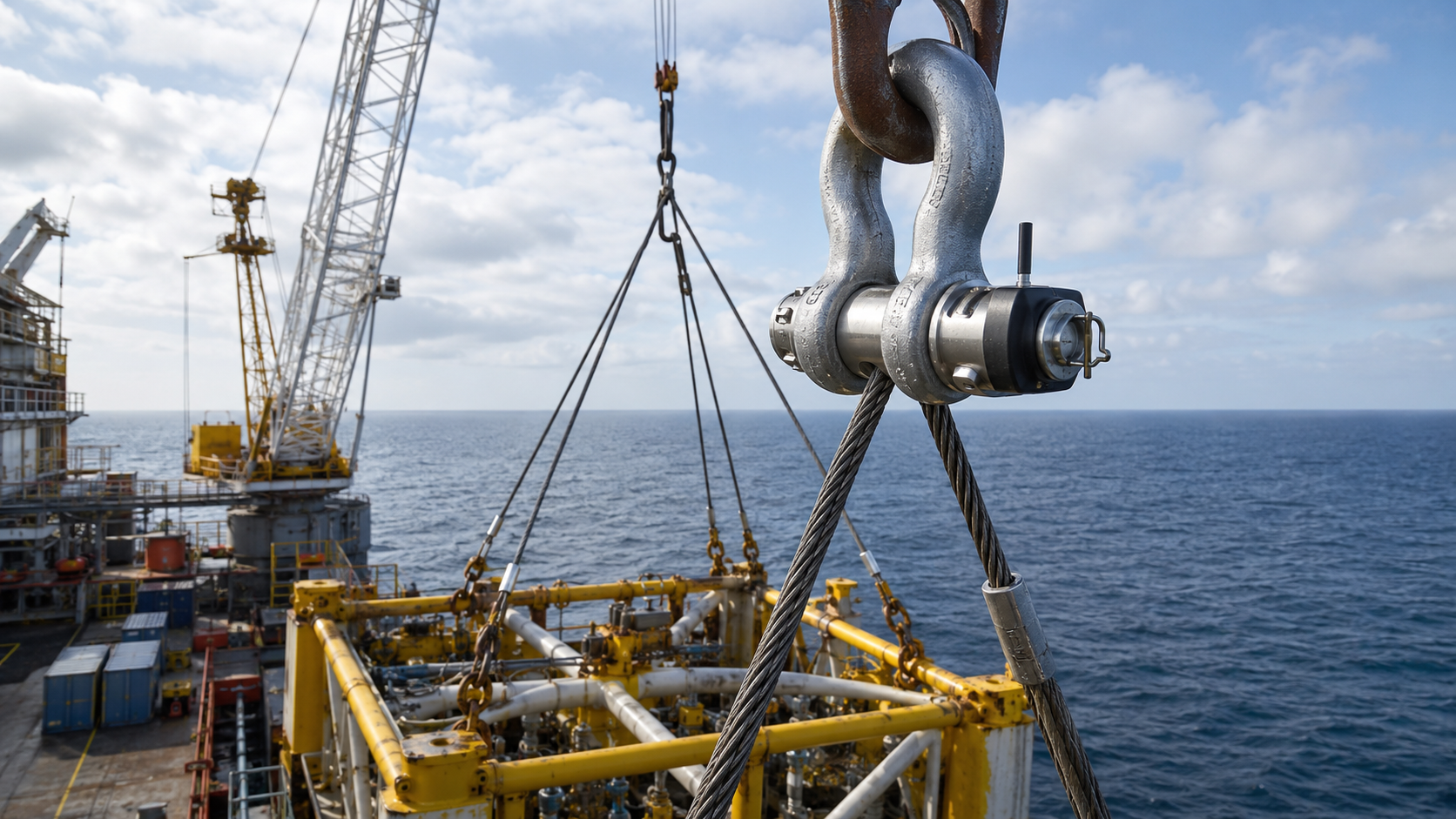
Load shackles are widely used in offshore lifting operations because they combine the lifting component and sensing element into a single compact assembly. They are often selected for temporary lifting operations, marine construction projects, proof load testing and offshore rigging applications where installation flexibility is important.
Rapid integration into existing lifting arrangements makes load shackles particularly useful where operators need portable load monitoring systems that can be deployed across multiple lifting tasks. Many offshore load shackles are also available with wireless telemetry systems, allowing operators to monitor loads remotely from a safe location.
Load pins are commonly chosen where the load sensing system needs to integrate directly into the structure or machinery itself. In offshore cranes, winches, sheaves and davits, a load pin can replace an existing structural pin without significantly altering the mechanical arrangement.
This approach provides a highly compact and protected installation while delivering continuous real-time load monitoring. Load pins are especially beneficial in offshore crane systems, mooring tension monitoring applications and riser tensioning equipment where long-term permanent monitoring is required.
Load cells are generally selected where there is sufficient installation space and where direct force measurement within the load path is preferred. Compression and tension load cells are widely used in offshore testing systems, structural monitoring applications and specialised lifting arrangements.
Matching the Load Monitoring System to the Application
The operating environment and lifting application have a major influence on equipment selection. Offshore cranes, for example, often require continuous load monitoring integrated into the control system. In these situations, load pins are often preferred because they can be incorporated directly into the sheave assembly or boom structure.
Anchor handling and towing operations typically involve highly dynamic loads and continual shock loading. Here, robust load shackles or tension load cells may be selected to withstand fluctuating tensile forces while providing accurate real-time monitoring.
Subsea lifting introduces additional considerations. Equipment may operate at significant depths where hydrostatic pressure, saltwater ingress and limited maintenance access become critical factors. Subsea load cells and load pins therefore require specialised sealing systems, corrosion-resistant materials and underwater connectors.
Mooring systems and riser tensioning applications often involve continuous long-duration loading cycles. Fatigue resistance becomes especially important in these installations, and the load monitoring system must be capable of maintaining reliable operation over many years of repeated stress cycling.
Proof load testing applications, by contrast, may prioritise portability and ease of installation. Wireless load shackles are commonly selected in these situations because they can be deployed quickly across a wide range of offshore lifting tasks.
Corrosion Resistance and Environmental Protection
Marine environments are merciless. Saltwater, humidity and continual environmental exposure can rapidly degrade inadequately protected systems.
For this reason, offshore load monitoring equipment is typically manufactured from stainless steel or other corrosion-resistant alloys. Duplex stainless steel is frequently used where additional strength and corrosion resistance are required – particularly in subsea operations.
Environmental sealing is equally important. Offshore load cells commonly feature fully welded construction and high ingress protection ratings such as IP 67 or IP 68 to prevent water ingress and internal corrosion. Armoured or polyurethane-sheathed cables are often specified to improve durability in demanding marine conditions.
Hazardous Area Certification Offshore
Many offshore installations operate within potentially explosive atmospheres where electrical equipment must comply with hazardous area regulations.
In these environments, load monitoring equipment may require ATEX or IECEx certification, depending on the installation location and operational requirements. Intrinsically safe systems are commonly specified offshore to minimise ignition risk while maintaining reliable signal transmission.
Hazardous area compliance should always be considered early in the specification process, particularly where the load monitoring system forms part of a larger integrated offshore control system.
Why Bespoke Offshore Solutions Are Often Preferred
Standard off-the-shelf load monitoring equipment may not always provide the optimal solution for offshore lifting applications. Mechanical constraints, environmental exposure and operational requirements frequently vary from one installation to another.
As a result, bespoke load pins, custom load shackles and application-specific offshore load cells are commonly developed for critical offshore systems. A custom-designed solution can improve installation efficiency, reduce structural modifications and provide greater long-term reliability under demanding operating conditions.
Bespoke systems may also incorporate integrated telemetry, specialised mounting arrangements, subsea connectors or enhanced environmental protection features tailored specifically to the application.
Get Expert Technical Advice
Benefit from LCM Systems’ 40+ years of experience in the design and manufacture of specialised load monitoring solutions for challenging applications. We can help you to specify the best load cells for safe and efficient offshore lifting.