
Which Certifications Are Required for Offshore Load Cells, Load Pins and Load Shackles? 📰
22nd May 2026Offshore operations take place in some of the harshest and highest-risk environments in industry. Equipment failure can have serious consequences for personnel safety, structural integrity, operational continuity and environmental protection.
As a result, offshore operators, EPC contractors and classification societies demand clear evidence that load monitoring equipment has been designed, manufactured and tested to recognised international standards.
The challenge for engineers is that there is no single offshore certification covering every application. Instead, offshore load monitoring equipment may require a combination of design approvals, material traceability, hazardous area certification, proof testing, calibration certification and third-party witnessing – depending on where and how the equipment will be used.
Understanding which certifications are genuinely required – and which are simply desirable – is essential when specifying offshore load cells, load pins and load shackles for critical lifting and tension-monitoring applications.
Why Certification Matters Offshore
Unlike many industrial environments, offshore installations operate under strict regulatory control. Equipment may be exposed to saltwater immersion, shock loading, extreme fatigue cycles, explosive atmospheres, and dynamic loading caused by vessel movement and wave action. Offshore lifting operations often involve extremely high loads, complex rigging geometries and safety-critical subsea deployment.
Certification provides the necessary assurance that the equipment has been independently verified for strength, reliability and suitability for the intended environment. It also ensures compliance with offshore project specifications, classification society requirements and international regulations.
In practical terms, properly certified equipment reduces project risk, simplifies approval processes and provides confidence during inspection and audit procedures.
Proof Load Testing and Calibration Certification
One of the fundamental requirements for offshore load monitoring equipment is proof load testing – combined with traceable calibration certification.
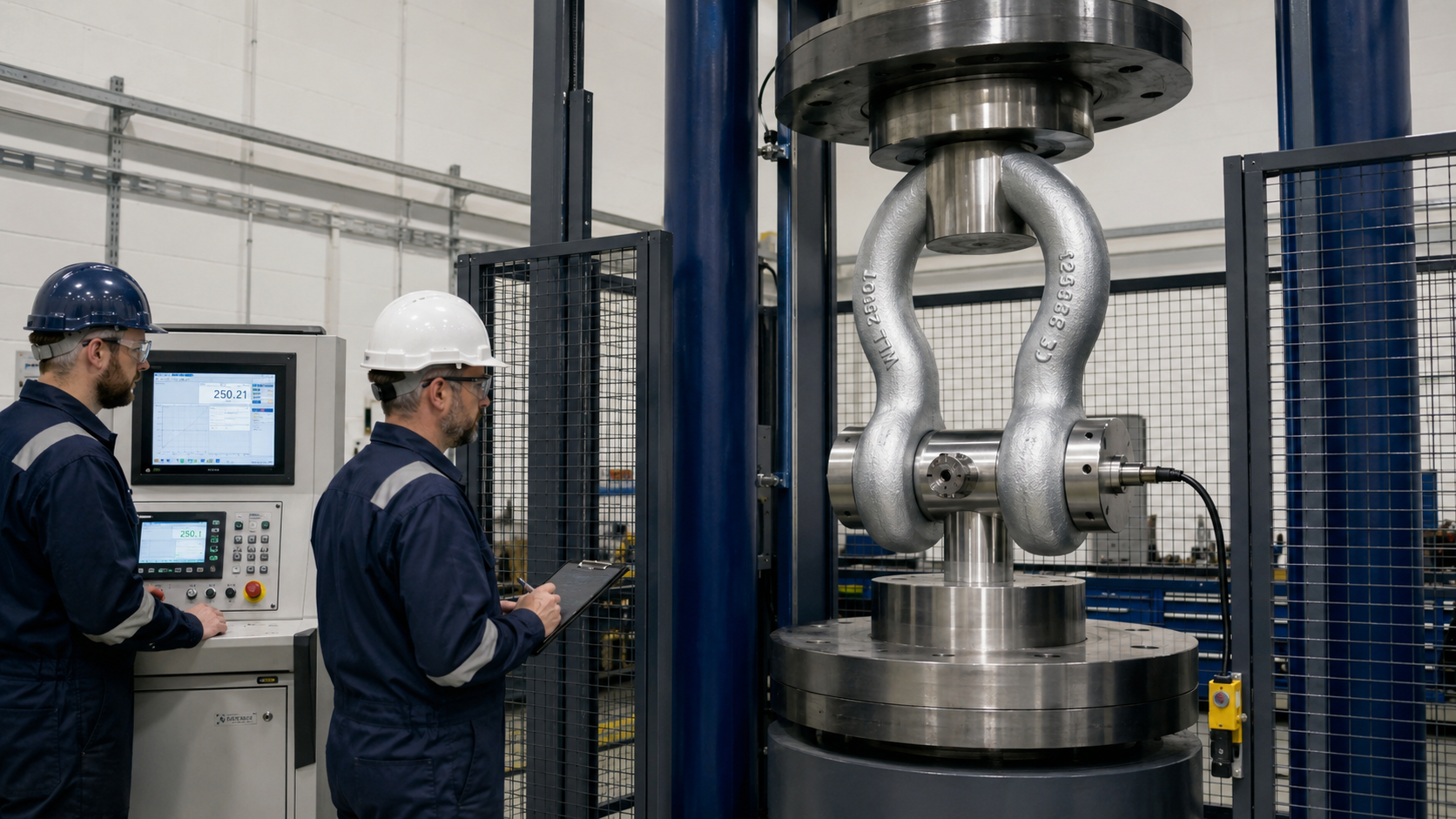
Load cells, load pins and load shackles are typically subjected to controlled loading in a calibrated test machine to verify both structural integrity and measurement accuracy. Offshore operators normally require calibration certificates traceable to national or international standards such as UKAS, ISO 17025 or equivalent accredited laboratories.
Calibration certification confirms that the device produces accurate and repeatable load measurements across its operating range. For offshore crane load monitoring, subsea lifting frames, mooring systems and riser tensioning applications, this level of traceability is often mandatory.
In many offshore projects, proof testing is witnessed by an independent third-party inspection authority before shipment.
DNV Certification
DNV certification is among the most widely recognised offshore approvals in the oil and gas industry. DNV, formerly known as Det Norske Veritas, provides standards and verification services for offshore structures, marine systems and lifting equipment (plus various other sectors).
For offshore load cells and load shackles, DNV witnessing commonly involves independent verification of proof load testing, dimensional inspection, material certification review and manufacturing quality procedures.
Many offshore contractors specifically request DNV witness testing because it provides independent assurance that the equipment has been manufactured and tested in accordance with recognised offshore lifting standards.
Although DNV approval is not legally required for every offshore project, it is frequently specified for high-value or safety-critical lifting, particularly in the North Sea and in international deepwater operations.
ABS, Lloyd’s Register and Other Classification Societies
In addition to DNV, offshore projects may require approval or witnessing from other marine classification societies such as ABS (American Bureau of Shipping), Lloyd’s Register or Bureau Veritas.
These organisations perform similar functions by independently verifying that offshore equipment meets the required design and testing standards. The specific classification society requested often depends on the vessel operator, offshore region or project specification.
For example, a subsea load shackle intended for deployment from a classed vessel may require ABS witness testing, while a North Sea installation contractor may specify Lloyd’s Register approval for lifting equipment associated with offshore crane operations.
Classification society involvement is especially common where load monitoring devices form part of a certified lifting assembly.
ATEX and IECEx Certification
One of the most important considerations for offshore load monitoring equipment is hazardous area certification.
Offshore oil and gas installations frequently contain potentially explosive atmospheres created by hydrocarbons, gases or vapours. Any electrical equipment installed within these hazardous zones must comply with strict explosion-protection requirements.
ATEX certification applies to equipment used within hazardous areas in the UK and Europe; some countries in the Middle East, Asia and South America also voluntarily accept or mandate ATEX-certified equipment. IECEx provides an internationally recognised certification framework for explosive atmospheres.
For offshore load cells and load pins incorporating strain gauges, signal conditioning electronics or wireless telemetry systems, hazardous area certification may be essential. This is particularly important for permanently installed monitoring systems used on drilling rigs, FPSOs, wellhead platforms and process modules.
Engineers must ensure that the certification matches the required zone classification, temperature class and gas group for the installation environment.
In many offshore applications, intrinsically safe designs are preferred because they minimise ignition risk by limiting electrical energy within hazardous areas.
Material Certification and Traceability
Offshore lifting equipment often requires full material traceability to verify the mechanical properties and origin of critical load-bearing components.
Material certification typically includes mill certificates confirming the chemical composition, heat treatment and mechanical properties of the steel used in the manufacture of load pins, shackles and load-bearing structures.
Subsea applications add further requirements: the stainless steels and corrosion-resistant alloys may require additional verification to demonstrate suitability for prolonged seawater exposure.
Full traceability is especially important in offshore lifting operations because operators need confidence that the materials used can withstand cyclic fatigue loading, corrosion and environmental degradation over extended service periods.
IP Ratings and Environmental Protection
Although not strictly a certification in the same sense as DNV or ATEX, ingress protection ratings are highly important offshore.
Load cells and instrumentation deployed offshore must withstand water ingress, salt spray, humidity and severe weather exposure. IP 67 and IP 68 ratings are commonly specified for offshore load monitoring systems – particularly in subsea applications.
For permanently submerged subsea load cells and load shackles, engineers must also consider long-term sealing integrity, subsea connector design and pressure compensation systems.
Environmental testing may include salt spray testing, temperature cycling and long-duration submersion trials to verify durability under realistic offshore conditions.
Quality Management Standards
Most offshore operators also require manufacturers to operate under recognised quality management systems such as ISO 9001.
This certification demonstrates that the manufacturer follows controlled production processes, maintains traceability records and applies documented quality assurance procedures throughout design and manufacture.
For offshore customers, ISO 9001 certification provides confidence that the supplier can consistently manufacture high-integrity load monitoring equipment suitable for demanding applications.
Choosing the Right Certification Level
The level of certification required depends heavily on the application itself. A portable load shackle used for occasional topside lifting inspections may require only calibration certification and proof testing, whereas a permanently installed subsea load pin operating within a hazardous zone may require DNV witness testing, ATEX approval, full material traceability and extensive environmental qualification.
This is why offshore load monitoring equipment should never be selected purely on load capacity alone. Engineers must consider the complete operational environment, project specifications, lifting regulations and classification society requirements before finalising the design.
Ultimately, certification is about risk reduction. In offshore oil and gas operations, independently verified load monitoring equipment provides assurance that critical lifting and tension measurement systems will continue to operate safely and accurately under some of the world’s most demanding conditions.
Get Further Information
Get specialist technical advice on the certifications required for monitoring loads in offshore operations. LCM Systems has 40+ years of experience in the design and manufacture of standard and custom force measurement solutions.