
Which Are The Best Load Cells For Wind Turbines? 📰
8th Jan 2026Which types of load cell will I need for my wind turbine applications?
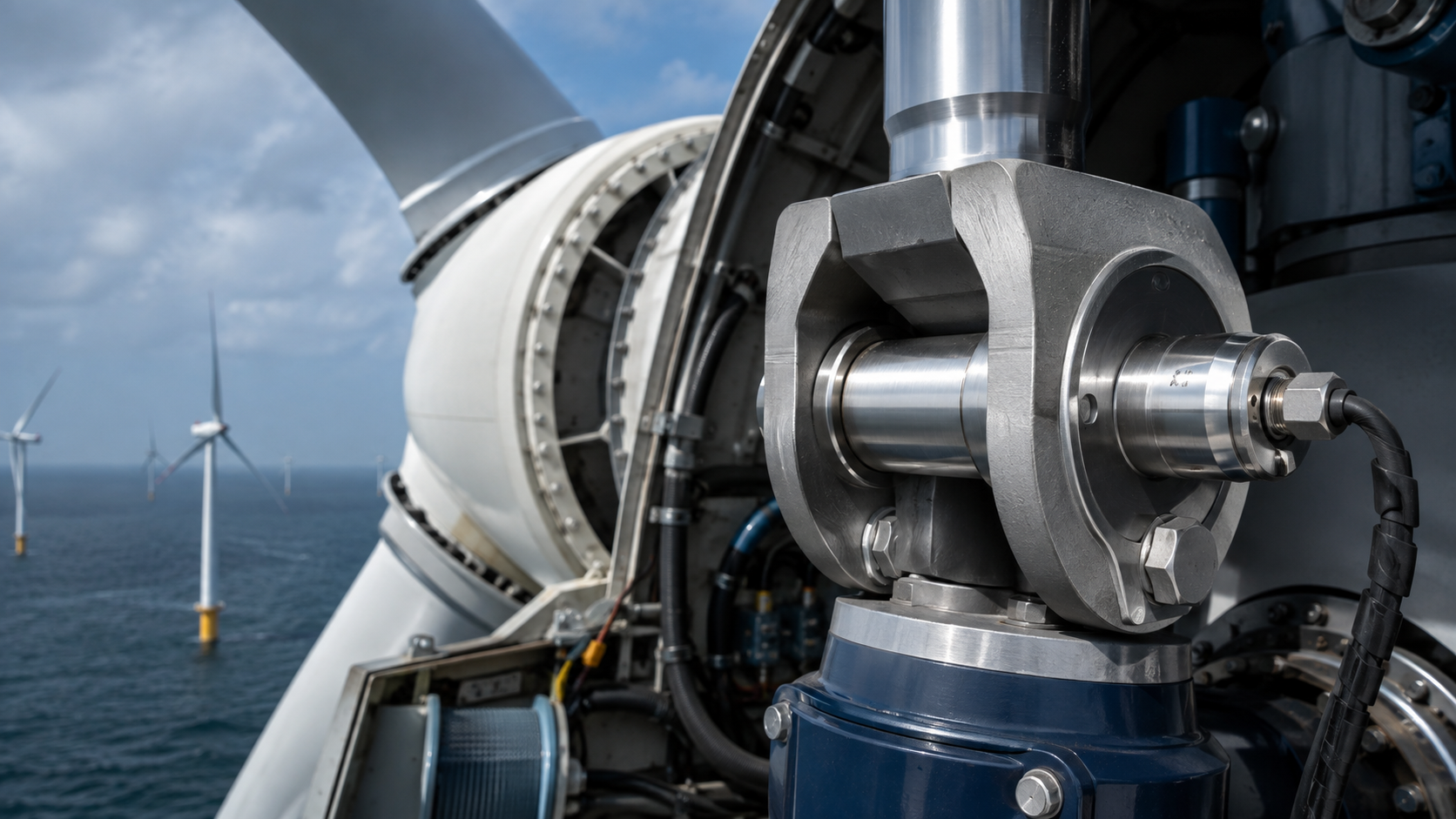
For wind turbine blade and pitch system loads, instrumented load pins installed in pitch links or actuator clevises are generally the best solution because they sit directly in the force path and can withstand high cyclic loads.
Yaw system loads in wind turbines are also best measured using load pins or force links, as these formats integrate easily into existing yaw drive or brake structures and tolerate vibration and high reaction forces.
Drivetrain and generator torque in wind turbines cannot be measured effectively with conventional load cells and are best monitored using rotary torque transducers designed for rotating shafts.
For floating wind turbines, mooring line tension is most reliably measured using subsea-rated load shackles or load links that act as primary load-bearing components and are engineered for long-term marine exposure.
Structural bolt preload, such as at tower flanges or yaw bearings, is best monitored using washer-type or through-hole load cells that directly measure bolt tension rather than inferred torque.
During installation and maintenance lifting on the wind turbine, portable tension load cells fitted to crane hooks or shackles are the most appropriate choice.
During wind turbine research, development and certification testing, high-accuracy canister, pancake or annular load cells are preferred due to their superior metrological performance, even though they are not typically used for long-term operation on the turbine.
How do measurement ranges and environmental specifications vary across wind turbine blade pitch systems, drivetrains, yaw systems, tower structures and floating wind moorings?
Load cells for blade root and pitch link measurement are typically required to handle forces in the region of 0 to 300 kN on a 3 MW turbine, increasing to as much as 1 MN on a 15 MW machine. The most appropriate sensor types for this application are instrumented load pins or, in some test and development cases, canister load cells. These sensors are normally specified to IP 67 or IP 68 ingress protection and are manufactured from stainless steel. Dual strain-gauge bridges and temperature compensation are commonly used to ensure reliability and signal stability under cyclic loading and varying environmental conditions.
Main shaft torque measurement requires a very different sensing approach. Torque levels can range from approximately 10 kN-m on smaller machines up to 5,000 kN-m on large offshore turbines. This application is best served by a rotary torque sensor rather than a conventional load cell. These sensors are typically rated to IP 67 and use non-contact telemetry or slip-ring systems to transmit data from the rotating shaft to the turbine control and monitoring systems.
Yaw brake and yaw drive loads generally fall in the range of 50 to 800 kN, depending on turbine size and design. Load pins or force links are the preferred sensor types because they integrate easily into the yaw system’s existing mechanical interfaces. These sensors are usually specified to IP 67 and – because the yaw system is safety-critical – are often implemented with dual redundancy to support fault detection and safe operation.
Loads at the tower base are typically very high, with equivalent axial and bending loads in the range of approximately 0.5 to 10 MN. These loads are rarely measured using a single packaged load cell. Instead, multi-axis strain gauge arrays or distributed sensing systems are used to infer the applied loads. Such instrumentation is generally specified to at least IP 67.
For floating wind turbines, mooring line tension is a critical measurement. Typical load ranges extend from zero up to around 5 MN, depending on the platform design and site conditions. The preferred solution for this application is a subsea-rated load shackle or load link, installed directly into the mooring line. These sensors are normally specified to IP 68 or full subsea standards, are depth compensated, and are manufactured from high-strength corrosion-resistant materials such as duplex stainless steel to ensure long-term reliability in harsh marine environments.
What are the main standards for wind turbine force measurement?
- IEC 61400-13:2015 – Measurement of Mechanical Loads on Wind Turbines
- DNV-ST-0437 – Loads and Site Conditions for Wind Turbines
- IEC 61000-6-2/-6-4 – EMC Immunity & Emission for Industrial Equipment
- ATEX Directive 2014/34/EU – Equipment for Explosive Atmospheres
- ISO 9227 – Salt-Spray Corrosion Test
- BS EN 10204 3.1 – Material Test Reports.
Contact LCM Systems for further information about wind turbine compliance.
Why LCM Systems for wind turbine load cells?
LCM Systems has years of expertise and experience in designing and manufacturing bespoke precision load cell solutions for wind turbines and other specialised renewable energy applications.
From integrating load cells into complex offshore wind jacket structures to ensuring seamless communication with SCADA and telemetry systems, every installation is engineered to meet stringent operational and regulatory standards – all under ISO 9001 quality management.
Our load cells, load pins, load shackles and load links are designed to withstand the corrosive marine conditions, extreme temperatures and dynamic loading cycles common in renewable power generation – delivering the accurate monitoring needed to prevent downtime and maintain optimal operational efficiency.
Contact LCM Systems for expert technical advice.