
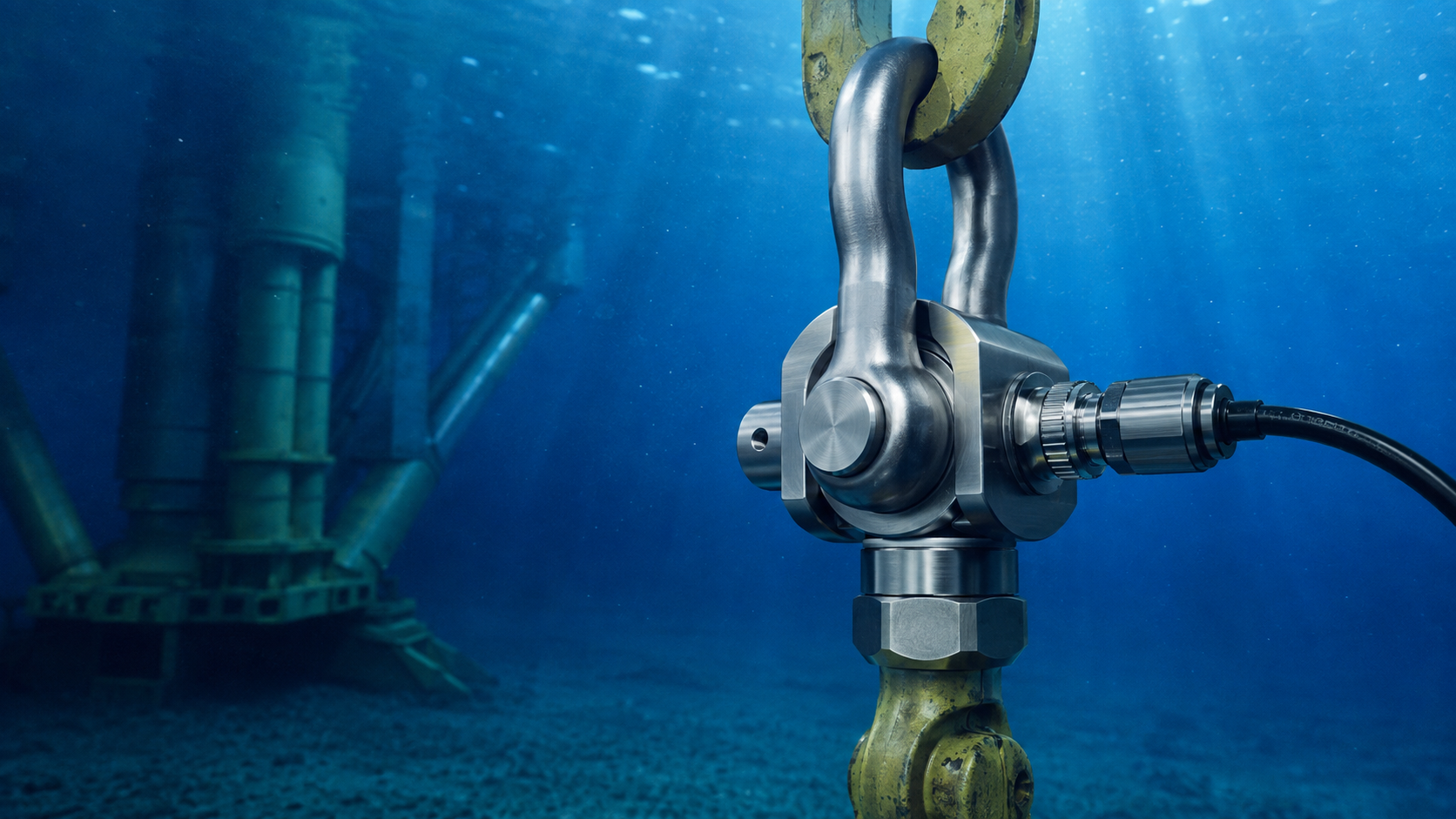
How Do Offshore Load Cells Withstand Harsh Marine Environments? 📰
19th May 2026For offshore load cells, load pins and load shackles, failure is not simply inconvenient. In many cases, it can compromise lifting safety, interrupt production operations and create significant operational risk. As a result, offshore load monitoring systems are engineered to far higher standards than conventional industrial weighing equipment.
Whether installed on offshore cranes, mooring systems, subsea handling equipment or winch assemblies, offshore load cells must be capable of delivering long-term accuracy and reliability while withstanding harsh marine conditions year after year.
Why Marine Environments Are So Demanding
Offshore operations present a unique combination of mechanical and environmental challenges. Saltwater is highly corrosive to many metals, while constant humidity accelerates oxidation and material degradation. At the same time, offshore equipment is subjected to continual vibration, dynamic loading and repeated stress cycles caused by wave motion and vessel movement.
Unlike sheltered industrial installations, offshore systems are also exposed to temperature fluctuations, driving rain, ultraviolet exposure and physical impact from heavy lifting operations. In subsea applications, hydrostatic pressure introduces another major engineering challenge – particularly for equipment operating at significant depths.
And given that maintenance access offshore is often difficult and expensive, load monitoring systems must be designed for exceptional durability and long service intervals.
Corrosion Resistance Through Material Selection
One of the most important ways that offshore load cells withstand harsh marine environments is through careful material selection. Standard industrial materials are often unsuitable for long-term offshore exposure, particularly in areas subject to continual seawater contact.
For this reason, offshore load cells are commonly manufactured from high-grade stainless steels or specialised corrosion-resistant alloys. Duplex stainless steel is frequently used in subsea and marine applications because it offers excellent resistance to chloride-induced corrosion while also providing high mechanical strength.
In certain applications, additional surface treatments or marine-grade protective coatings may also be applied to further enhance corrosion resistance. These coatings help to protect exposed surfaces from salt spray, moisture ingress and environmental degradation during long-term offshore deployment.
The choice of material becomes especially important for offshore load pins and load shackles, which may experience both high tensile forces and continual environmental exposure during lifting operations.
Preventing Water Ingress and Internal Damage
Water ingress is one of the greatest threats to offshore electronics. Moisture entering the sensing element or electrical connections can lead to signal instability, corrosion and eventual equipment failure.
To prevent this, offshore load cells are designed with advanced sealing systems capable of maintaining long-term environmental protection. Fully welded stainless steel constructions are commonly used to eliminate potential ingress paths, while specialised sealing compounds protect internal strain gauge assemblies.
Many offshore load cells achieve high ingress protection ratings such as IP 67 or IP 68, enabling them to withstand prolonged exposure to water and harsh weather conditions. In subsea applications, pressure-compensated sealing systems and underwater connectors may also be incorporated to ensure reliable operation at depth.
Cable protection is equally important. Offshore cables are often armoured or polyurethane-sheathed to resist abrasion, seawater exposure and mechanical damage during installation and operation.
Designing for Fatigue and Dynamic Loading
Unlike static weighing applications, offshore lifting systems are continually subjected to dynamic loading. Vessel motion, wave action and sudden load shifts can generate shock loads and repeated stress cycles that place enormous strain on both the mechanical structures and the load monitoring equipment.
To withstand these conditions, offshore load cells are engineered with fatigue resistance in mind. Mechanical stress concentrations are minimised through careful design, while high-strength materials help to maintain structural integrity under repeated loading conditions.
Load pins used in offshore cranes and winches are particularly susceptible to cyclic loading and therefore require detailed fatigue analysis during the design process. In critical applications, finite element analysis is often used to optimise stress distribution and maximise long-term reliability.
Shock loading protection may also be incorporated into the mechanical arrangement to reduce the impact of sudden force spikes during heavy lifting operations.
Subsea Load Cells and Pressure Resistance
Subsea applications introduce additional environmental challenges that standard load cells are simply not designed to handle. At increasing water depths, hydrostatic pressure rises significantly, creating the potential for seal failure and structural deformation.
Subsea load cells are therefore engineered with pressure-resistant housings and specialised sealing systems capable of operating reliably under extreme underwater conditions. In many cases, these systems are tested in hyperbaric chambers to verify long-term subsea performance before deployment.
Subsea connectors and underwater cable assemblies are also carefully selected to prevent water ingress while maintaining signal integrity throughout the operating life of the system.
These technologies are widely used in subsea construction, pipeline installation, ROV handling systems and offshore renewable energy projects where accurate underwater load monitoring is essential.
Read more on our Submersible blog
Hazardous Area Protection Offshore
Many offshore oil and gas installations contain potentially explosive atmospheres created by flammable gases and vapours. Electrical equipment installed within these areas must therefore comply with strict hazardous area safety standards.
Offshore load cells intended for hazardous areas are commonly designed to meet ATEX or IECEx certification requirements. This ensures the equipment can operate safely without creating ignition risks in potentially explosive environments.
Depending on the application, systems may incorporate intrinsically safe electronics, flameproof enclosures or other protective measures to meet offshore safety regulations.
Hazardous-area certification is particularly important for offshore cranes, drilling systems and production platforms where load monitoring equipment operates close to hydrocarbon processing areas.
The Importance of Bespoke Offshore Load Monitoring Solutions
No two offshore installations are exactly alike. Differences in equipment geometry, environmental exposure, load capacity and operational requirements often mean that standard off-the-shelf load cells are not the ideal solution.
For this reason, many offshore operators choose bespoke load monitoring systems specifically engineered for the application. Custom load pins, subsea load cells and specialised offshore load shackles can be designed to integrate directly into existing structures while meeting the environmental and operational demands of the installation.
A bespoke approach often improves both reliability and ease of installation while ensuring the load monitoring system performs effectively throughout its operational life.
Get Expert Technical Advice
Partner with LCM Systems, the specialist load cell manufacturer with 40 years of experience. Our expert team can help you to specify the best load cells for safe and efficient offshore oil and gas operations.
Contact LCM Systems for specialist advice on offshore load monitoring.