
Which Load Cell Types Are Best for Offshore Oil and Gas Applications? 📰
14th May 2026Saltwater corrosion, heavy shock loading, continual vibration and extreme weather conditions all create significant challenges for offshore load monitoring systems. In many cases, equipment must also operate safely within hazardous areas. Selecting the correct type of load cell is critical – not just for operational efficiency but also for safety, compliance and long-term reliability.
Why Offshore Applications Require Specialised Load Cells
Unlike standard industrial weighing systems, offshore load monitoring applications are rarely static. Loads can fluctuate rapidly due to wave motion, vessel movement and dynamic lifting operations. Equipment is frequently exposed to seawater spray, high humidity and wide temperature variations, while maintenance access may be limited or costly.
For this reason, offshore load cells are typically manufactured from corrosion-resistant stainless steel and designed with high ingress protection ratings. Many systems also incorporate specialised sealing arrangements, fatigue-rated designs and protective coatings to maximise service life in marine environments.
In hazardous areas, ATEX/IECEx certified load cells may also be required to ensure safe operation in the potentially explosive atmospheres commonly found on offshore platforms and drilling vessels.
The most suitable load cell for an offshore oil and gas application will depend on the installation itself, the mechanical arrangement, environmental conditions and the level of accuracy required. However, several load cell types are widely recognised across the offshore sector for their durability and performance.
Load Pins for Offshore Cranes and Winches
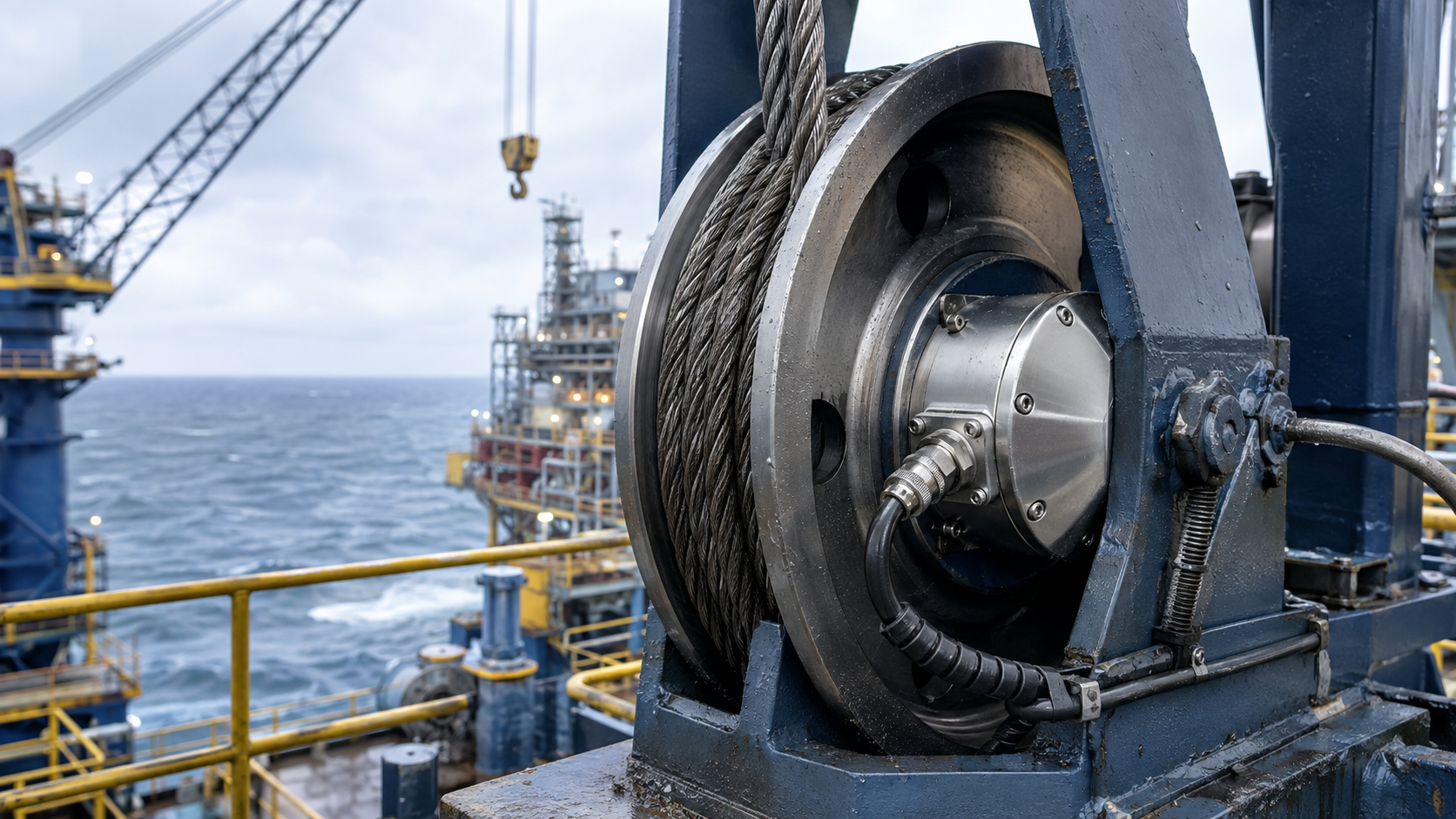
Load pins are among the most commonly used load monitoring solutions in the offshore oil and gas sector. Rather than introducing an additional component into the lifting arrangement, a load pin is designed to replace an existing structural pin within equipment such as cranes, sheaves, winches or davits.
A correctly specified load pin will provide highly accurate force measurement while maintaining a compact and mechanically efficient installation. And because the sensing element is integrated directly into the pin itself, the overall system remains robust and well protected against accidental damage.
Load pins are particularly well suited to offshore cranes and winch systems where space may be restricted and where operators require continuous real-time load monitoring. They are also widely used in mooring tension monitoring systems and riser tensioning applications where long-term reliability is essential.
For subsea applications, load pins can be designed with fully sealed construction and integrated subsea connectors to withstand prolonged underwater deployment.
Load Shackles for Offshore Lifting Operations
Load shackles are another popular choice for offshore lifting and handling applications. These units combine a high-strength lifting shackle with an integrated load cell – enabling operators to monitor loads directly within the lifting arrangement.
Swift and simple installation/removal means that load shackles are often used for temporary lifting operations, load testing and marine construction projects. They are particularly useful where flexibility is required across multiple lifting applications.
Offshore load shackles are typically manufactured from high-tensile alloy steel or stainless steel. They can be supplied with wireless telemetry systems for remote monitoring. Wireless systems are especially beneficial offshore, where long cable runs may be impractical or vulnerable to damage.
In dynamic marine lifting operations, wireless load shackles also allow operators to monitor loads safely from a remote location, improving both operational visibility and personnel safety.
Compression Load Cells for Heavy Offshore Structures
Compression load cells are frequently used where extremely high loads must be measured with exceptional stability and accuracy. These load cells are designed to measure compressive forces and are commonly installed beneath offshore structures, tensioners or jacking systems.
In offshore applications, compression load cells are often selected for their high load capacity and robust construction. They are capable of handling very large static and dynamic forces while maintaining reliable performance in demanding environments.
Many offshore compression load cells are custom designed to suit the mechanical arrangement of the installation. This may include specialised mounting arrangements, anti-rotation features or integrated environmental protection systems.
Tension Load Cells for Wire Rope Monitoring
Tension load cells are widely used to monitor offshore winches, anchor handling systems and towing operations. These load cells are designed specifically to measure tensile forces; they are often incorporated into line monitoring systems.
In offshore environments, accurate wire tension monitoring is critical for maintaining safe operating limits and preventing equipment overload. Tension load cells can also help operators to optimise lifting efficiency and reduce wear on expensive offshore equipment.
Modern offshore tension load cells are commonly supplied with digital output signals and integrated data logging capabilities, enabling real-time monitoring from centralised control systems.
Subsea Load Cells for Underwater Operations
Subsea load monitoring presents an entirely different set of engineering challenges. Equipment may operate at significant depths while exposed to hydrostatic pressure, saltwater ingress and long deployment periods without maintenance.
Subsea load cells are therefore designed with fully sealed pressure-resistant housings and specialised underwater connectors. Selection of materials becomes especially important with duplex stainless steels and other corrosion-resistant alloys frequently used to maximise durability.
These systems are commonly deployed in subsea construction, ROV operations, pipeline installation and offshore renewable energy projects where accurate underwater load measurement is essential.
Read more on our Submersible blog
Wireless Load Monitoring Offshore
Wireless technology has become increasingly important within offshore load monitoring systems. Traditional cabled systems can be difficult to install and maintain on offshore structures, particularly where moving equipment or temporary lifting operations are involved.
Wireless load cells and load shackles simplify installation while allowing operators to monitor loads remotely from safe locations. Many offshore wireless systems now offer long transmission ranges, encrypted communications and battery technologies designed for extended offshore deployment.
This technology is especially valuable during heavy lifts, offshore construction projects and marine salvage operations where operational flexibility is essential.
Specifying the Best Offshore Load Cell
Selecting the best load cell for your offshore oil and gas application requires careful consideration of both the operating environment and the mechanical installation. Factors such as load capacity, environmental exposure, fatigue loading, hazardous area certification and installation constraints must all be assessed during the specification process.
In many cases, standard load cells may not provide the level of durability or integration required offshore. Bespoke load pins, custom load shackles and application-specific load monitoring systems are therefore often preferred for critical offshore operations.
Get Expert Technical Advice
It is important to partner with an experienced load cell manufacturer, such as LCM Systems, that understands offshore engineering requirements. Our extensive technical expertise in this specialised field will help you to enhance system reliability and operational safety.
Contact our specialist team for expert technical advice on offshore load monitoring.