
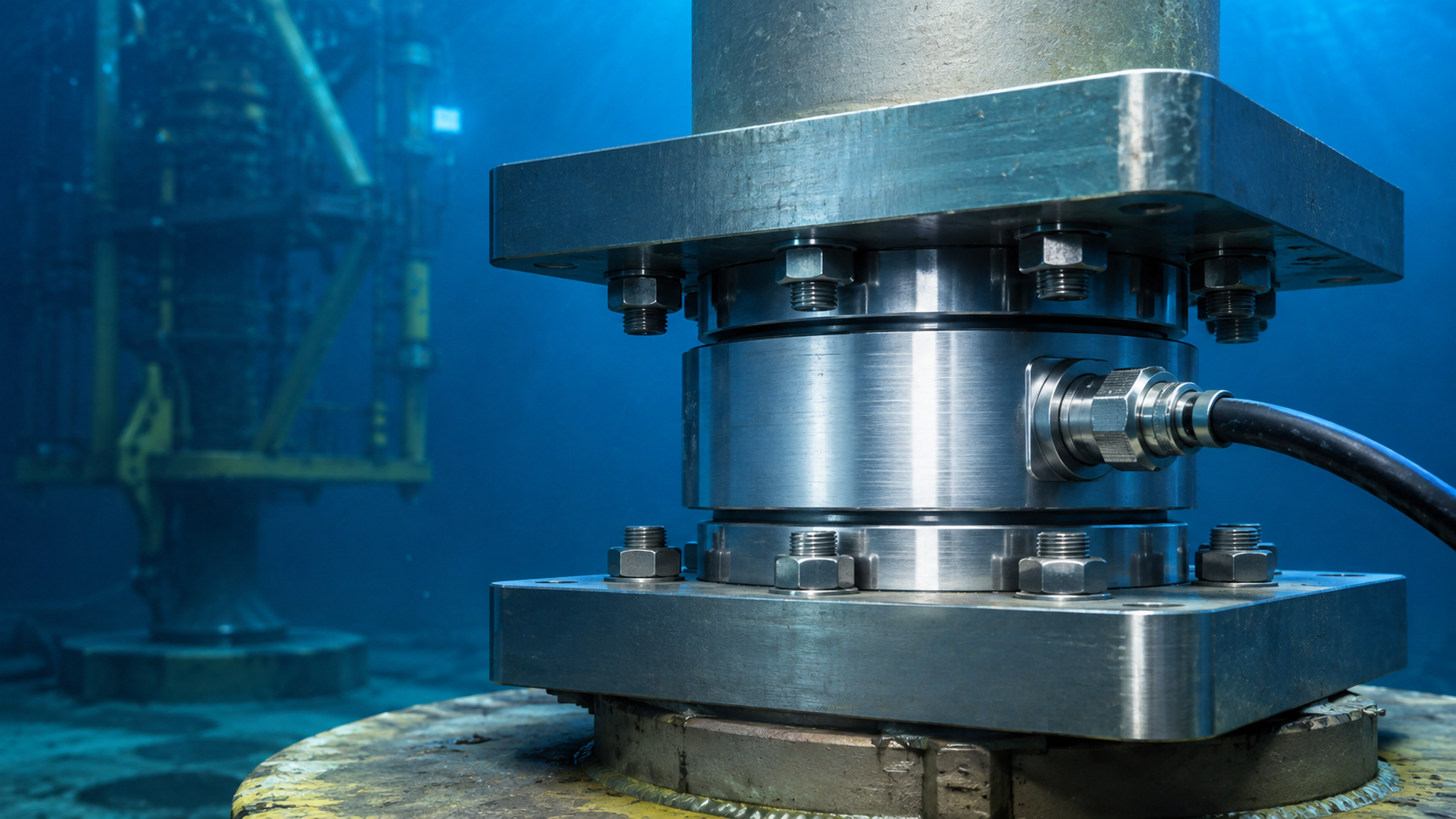
Subsea Load Cells for Offshore and Deepwater Applications: What Really Matters 📰
14th May 2026Why Specifying Subsea Load Cells Requires Extra Care
When specifying a subsea load cell for offshore or underwater applications, marine engineers face a very different set of challenges compared with conventional industrial environments. In subsea operations, failure is not merely inconvenient – it can result in costly vessel downtime, failed lifting operations, damaged infrastructure or expensive retrieval operations.
Subsea load cells, load pins and shackles must survive extreme pressure, exposure to saltwater, dynamic loading and long-term immersion – all while maintaining reliable and accurate performance.
Why Subsea Applications Are So Demanding
Subsea environments are among the harshest operating conditions for any force measurement system. Hydrostatic pressure increases by approximately 1 bar every 10 metres of depth, meaning a sensor deployed at 3,000 metres may experience over 300 bar of external pressure.
At the same time, subsea load monitoring systems must withstand continuous seawater exposure, corrosion, galvanic attack, shock and vibration, dynamic wave loading, fatigue stress, temperature fluctuations and cable/connector water ingress.
For offshore lifting, mooring monitoring, ROV tooling and underwater tension measurement, reliability becomes the primary engineering concern.
The Difference Between ‘Marine’ and True Subsea Load Cells
One of the biggest mistakes in offshore specification is assuming that a standard marine-rated load cell is suitable for permanent submersion.
Many conventional marine load cells are designed only for splash-zone environments or for temporary immersion. A true subsea load cell should be engineered specifically for continuous underwater operation and pressure resistance.
Marine engineers should look for:
- IP 68 or higher ingress protection
- fully welded stainless steel construction
- hermetically sealed strain gauge chambers
- subsea-rated connectors and cabling
- pressure compensation systems
- offshore proof-load certification
- long-term corrosion resistance.
Without these features, even a high-quality industrial load cell may fail prematurely underwater.
Material Selection Is Critical
Material selection is one of the most important considerations when specifying a subsea load pin or shackle.
It is obvious that seawater is highly corrosive – particularly in deepwater or long-duration deployments. Most high-performance subsea load cells use materials such as:
- 17-4 PH stainless steel
- duplex or super duplex stainless steel
- titanium for premium deepwater applications.
Correct material selection helps to prevent corrosion pitting, stress corrosion cracking, fatigue failure and galvanic corrosion between dissimilar metals.
For long-term offshore reliability, marine engineers should also ensure that all subsea connectors, cable glands and fasteners are compatible with the primary sensor material.
Why Subsea Connectors Matter
In many offshore systems, the weakest point is not the load cell itself but the connector and cable assembly.
For critical offshore applications, cable protection can be just as important as the load cell design itself.
Water ingress through poorly specified cable systems is one of the most common causes of subsea instrumentation failure. Engineers specifying a subsea load cell should therefore consider:
- wet-mate or dry-mate subsea connectors
- water-blocked cable assemblies
- polyurethane-jacketed subsea cables
- strain relief protection
- pressure-resistant sealing systems.
Fatigue Resistance and Dynamic Loading
Unlike static industrial weighing systems, offshore environments generate highly dynamic loading conditions.
Subsea load cells used in mooring monitoring, offshore cranes, winches and lifting systems are exposed to continuous cyclic stress caused by wave action, vessel movement, snatch loading, heave compensation systems and dynamic deployment operations.
Over time, fatigue becomes a major design concern.
High-quality subsea load pins and load shackles are therefore engineered using advanced Finite Element Analysis (FEA) and fatigue validation testing to reduce stress concentrations and maximise service life.
Accuracy Under Pressure
Hydrostatic pressure can affect the accuracy of poorly designed subsea load cells by inducing false strain within the sensor body.
To maintain reliable measurement performance, advanced subsea load cells may incorporate:
- pressure-compensated chambers
- differential sensing systems
- temperature compensation
- oil-filled pressure balancing systems.
Marine engineers should always confirm whether the load cell has been calibrated and tested under representative subsea conditions, rather than in air only.
Offshore Certification and Traceability
For many offshore applications, certification is essential.
Marine engineers frequently request compliance with standards such as DNV, ABS, Lloyd’s Register, ATEX, IECEx and UKAS traceable calibration.
Independent proof-load testing and material traceability provide additional confidence that the subsea load cell will perform safely in critical offshore operations.
Recommended LCM Systems Subsea Load Cells
LCM Systems offers various high-quality subsea load cells, subsea load shackles and subsea load pin solutions suitable for harsh offshore environments.
1. LCM3064 150te Subsea Load Shackle
Designed for demanding subsea use with 500 psi submersion capability, protected subsea cable assembly, subsea connector and ABS witnessed testing.
View the specifications, test results and drawings >>
2. LCM1410 550te Subsea Compression Load Cell
A fully submersible IP 68 stainless steel compression load cell with long-term offshore durability.
View the specifications, test results and drawings >>
3. LCM3511 85te Subsea Bow Load Shackle
Suitable for permanent shallow subsea deployment to 45 metres with robust offshore construction.
View the specifications, test results and drawings >>
4. LCM4570 12te Subsea Load Shackle with Data Logging
Ideal for aquaculture and shallow mooring monitoring applications requiring long-term subsea data collection.
View the specifications, test results and drawings >>
5. LCM Systems Subsea Load Pins
LCM Systems manufactures custom subsea load pins for offshore and underwater applications when specified with appropriate sealing, subsea connectors and corrosion-resistant materials.
View our range of load pins >>
Final Thoughts
When specifying a subsea load cell for offshore applications, the cheapest solution is rarely the most cost-effective. Reliability, survivability and long-term performance should always take priority over initial purchase price.
A properly engineered subsea load pin or load shackle can operate reliably for years in some of the harshest environments on earth — but only if it has been designed specifically for subsea service from the outset.